A PLACE TO LEARN AND WORK
PART 5. DEVELOP AND MAINTAIN ADEQUATE AND APPROPRIATE EDUCATION
FACILITIES
This part of the report is organized according to five major school
facility policy areas: (1) assuring stable and adequate funding; (2) allocating
funds equitably to meet local needs; (3) establishing high standards and
accountability; (4) promoting efficiency and effectiveness in the use of capital
resources; and (5) establishing environmental review procedures appropriate to
assuring a healthy learning environment.
We believe that a world-class public education system must include state and
local financial support of and shared responsibility for quality educational
facilities. While specific criteria must be developed to determine and ensure
adequacy for school facilities, there is no doubt that the current model of
funding for public school facilities in California is unresponsive to planning
and funding needs of school districts, and, therefore, results in the
inefficient use of resources for facilities. In particular, reliance solely on
state general obligation bonds and the current method of allocating bond
proceeds creates a system that has not been conducive to long-term planning for
school facility needs at the local level, and that fails to leverage or
encourage the development of local sources of funding for school capital
needs.
Therefore, we recommend that the current system of providing state
facilities financing to school districts should be replaced with a system that
ensures that state funding is stable, reliable, and available when needed.
School districts would be responsible for assuring a stable source of local
revenue to supplement state funding for local facility needs. We also believe
that school districts need greater flexibility to use funds most effectively at
the local level. Realizing that many school districts have spent several years
developing their project applications under the current state allocation system
and that they are prepared to construct or modernize facilities when bond funds
become available, those districts should be allowed to complete their projects
under the current system. We suggest that a transition occur from the current
system of state support that relies solely on the allocation of bond proceeds to
a system that provides annual appropriations to districts, with the requirement
that districts will supplement these annual appropriations to meet state
standards and achieve the goals of district school facilities plans.
We
further suggest that this transition be structured to ensure that the existing
construction / modernization backlog and the needs of critically overcrowded
schools that currently exist are given high priority for state bond funding
during the transition period. Thereafter, state bond funds would continue to be
used to assist districts that experience difficulties in generating their local
match, have special needs, or experience unforeseen problems such as natural
disasters. The following sections elaborate on these goals.
Goal: Provide an adequate, stable and reliable source of funding that is available when needed and that addresses current and future capital outlay needs[27].
Recommendation 5.1:The working group recommends that the current funding model be replaced with annual state per-pupil allocations that are restricted to assisting school districts in meeting their capital and major maintenance needs according to a long-term Facilities Master Plan adopted by each school district. State and local funding for capital and major maintenance should be protected to prevent the redirection of capital resources when other cost pressures arise and to protect the citizenry’s investment in major capital projects. |
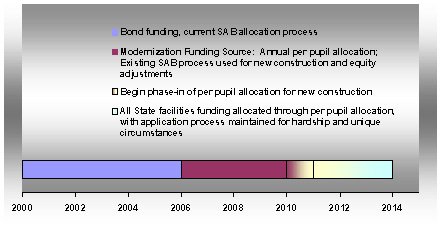
Recommendation 5.2:The working group recognizes that moving to a new paradigm for school facilities funding will require a transition period. We recommend that a ten-year transition plan be adopted during which the reliance on state General Obligation bonds to fund facilities will be phased out and funding through annual per-pupil allocations from the state General Fund will be phased in. |
(Chart 2)
2002-2006: State facilities funding will continue to be provided primarily through statewide bonds and through the current application process for the purpose of making existing facilities adequate. Specifically, we recommend that through 2006, priority for state bond funding be given to projects that will clear the current backlog. In addition, we recommend a set-aside of funds specifically for districts with critically overcrowded schools, as defined by the Legislature. Further, we recommend that planning and necessary legislation be adopted during this period to begin moving to a per-pupil allocation system in 2006.
2006-2008: We recommend that the state, beginning in 2006,
transition to a new per-pupil allocation model by providing annual
apportionments to school districts for use in renovation, modernization and
major maintenance projects. School modernization projects would be funded from a
per-pupil allocation model sufficient to support a projected level of
modernization need for a future period of 25 years, amortized to establish an
appropriate annual per-pupil allocation amount. New construction, equalization
efforts and special adjustments will continue to be funded through the State
Allocation Board’s application process, but reliance on that process
begins to diminish.
2008-2010: Gradually phase out facilities
funding through the existing allocation process, so that, by 2010, the state has
fully adopted a financing system for the construction of new facilities through
annual state per-pupil allocations. This annual allocation will be restricted
and protected by law to meet established Quality School Facility (QSF) standards
and school districts would provide local resources to supplement the
State’s QSF allocation to ensure adequate funding, should districts’
facilities master plans determine that such local participation is necessary.
Ongoing maintenance would continue to be funded from district Proposition 98
allocations.
After 2010: The primary source of capital outlay
funding for K-12 education is a constitutionally guaranteed annual allocation,
the level set by the state and supplemented with local resources. This
constitutional guarantee, while similar to Proposition 98, would not otherwise
impact the calculations used to determine state funding of school operations
under Proposition 98. With the advent of Quality School Facility allocations to
school districts and the expectation that school districts will provide locally
raised supplemental funding, there are likely to remain some low-wealth
districts that will be unable to provide their full contingent of local match,
growing districts that may have capital and ongoing maintenance needs that
exceed the level of funding provided under the QSF formula, or special funding
needs brought on by unforeseen circumstances such as natural disasters.
Therefore, after 2010, the State should maintain an application-based process to
address the additional school facilities needs that may occur as a result of
these special circumstances.
Local school districts will be expected to
supplement the State per-pupil allocations for capital outlay from their
Proposition 39 bonding capacity, from developer fee revenues or any other local
source available to the district. Moreover, the Legislature should consider
establishing additional local revenue options (e.g., tax increment financing)
that would supplement currently available sources.
Goal: Facilities funding must be equitably allocated to meet the
local needs of school districts throughout the state.
Within the
framework of the funding model that the working group is recommending, there are
three issues within the topic of allocations and equity that were discussed and
addressed:
The working group recommends that the state base per-pupil grant amount be
appropriate to the varying levels of education. For instance, the base
per-pupil allocation for an elementary school district should not be equivalent
to the base per-pupil allocation for a unified school district.
Students and teachers within and among school districts throughout the state
should work and learn in facilities that will promote and support a high quality
education. Meeting the existing backlog of need for facility construction,
renovation and repair will “level up” all facilities in the state to
a comparable standard of adequacy. The group proposes to achieve this by
emphasizing within the years of 2002-2006 state bond funding based upon
projected need. Once all school districts have achieved levels of adequacy for
their facilities and the state transitions into its base per-pupil allocation,
the issue of equity moves from one of “leveling up” to one of
accommodating special circumstances.
While it is anticipated that a standardized per-pupil allocation for each
type of school will be developed to support Quality School Facilities, and that
this allocation will be adjusted annually to reflect rising construction costs,
the working group recognizes that there are some special circumstances among
school districts throughout the state that may increase the cost of facilities
construction.
Recommendation 5.3:Therefore, we recommend that the Legislature consider authorizing a limited number of adjustments to supplement the state base per-pupil allocation. As with our recommendations for adjustments to school operating fund allocations (see the Part 2: Categorical Program Adjustments), we believe special circumstances related to geography, land use and unique school district factors may warrant consideration for additional funding beyond the annual per-pupil grant.[29] |
Goal: Through common standards and accountability systems for
schools throughout the state, assure that all students, teachers, administrators
and other staff have appropriate learning and working environments to provide a
high quality education. Assure that standards are met and maintained in each
school through appropriate monitoring, assistance and
intervention.
Common standards will establish an expectation of the
condition and quality of school facilities throughout the state. The linkage of
the standards to a reliable source of annual state funding is direct and
logical: The state establishes the expectations and guarantees the provision of
resources to meet them. The condition and quality of each district’s
facilities will be measured against the standards in the first year and
deviations from the standards will be identified. The specific facility
deviations from the standards are addressed in a five-year corrective action
plan, which quantifies the facility needs of the district in terms of capital
dollars needed. The action plan is a part of the Facilities Master Plan of the
District.
Recommendation 5.4:Establish clear, concise and workable standards that are characteristic of facilities that provide a high quality/high performance teaching and learning environment. |
The Facilities Group recommends the following language be amended to
Education Code Section 17251(g) in reference to developing statewide facilities
standards:
Education Code Section 17251 (g)--The California Department of
Education shall develop standards for use by school districts to evaluate
existing school facilities. The application and use of the state standards is
the responsibility of the local school district governing board. The standards
shall include, but not be limited to, the following categories:
1)
Classrooms: address the adequacy of the number and size of classrooms to
deliver the local educational program
2) Maintenance: address the conditions
of the building – good repair, painted, roofs in good condition, and
inspections occur on an adequate periodic basis
3) Cleanliness: address
litter and graffiti; assure clean and adequate food preparation and serving
facilities
4) Safety: address fire hazards, emergency telephone
accessibility, air quality, and other health issues.
7) Drinking water:
fountains are operable, safe, and clean
Recommendation 5.5:We recommend that each school district prepare and, with appropriate public review, adopt a five-year facilities plan to meet or exceed state facilities standards[30]. |
Recommendation 5.6:Adopt necessary policy and statutory changes so that the annual budget for each school district includes a capital spending component that is reviewed and assessed as part of the AB 1200 financial and management accountability process. Technical assistance, which may be warranted based on such a review, shall be available to school districts through regional and state agencies. |
Recommendation 5.7:It is the recommendation of the group that the state create a statewide school facilities inventory system that will assist state and local decision makers to determine short and long term school facilities needs. It is imperative that the state collects only the most critical, basic information needed to make necessary management decisions. The state will utilize information contained in existing data collection reports before requiring school districts to report any additional information needed for the school facilities inventory system. |
If, as part of developing or updating its Facilities Master Plan, a school district finds that its capital and ongoing maintenance needs are less than the amount projected from the State’s QSF allocation, matched by local effort, the school district may reduce its local effort proportionate to the reduced level of total funding needed. If, as part of this process, a school district finds that its capital and ongoing maintenance needs are less than the amount projected solely from the State’s QSF allocation, the state will reduce the QSF allocation to that district accordingly.
Regarding public education at large, the role of the local school district is
to coordinate and implement an educational program conducive to academic
excellence and achievement. Part of such a program is to provide adequate
educational facilities that are safe, clean, appropriate and conducive to high
quality education. Local school districts achieve facilities goals in tandem
with state efforts through a partnership to provide adequate, stable and
reliable funding.
Recommendation 5.8:The Working Group recommends that local districts be given autonomy to expend state and local funds as appropriate to meet their local educational programs insofar as such expenditures of funds enables the district to meet or exceed statewide standards for adequate facilities. Local districts would be subject to required, annual self-assessments and assessments against their Facilities Master Plans, and be required to publicly share the results of those assessments with members of their communities – students, parents, and community leaders – annually. |
Goals:
Recommendation 5.9:The working group recommends that the state provide financial incentives to school districts to promote joint or shared use of facilities. We also recommend that the state develop a technology infrastructure among, between and within educational entities that would promote improved education delivery and access to a wider range of education resources. This system of shared facility and technology infrastructure would allow districts and schools to better manage and assess financial and physical resources. |
Goal: Develop statewide environmental standards appropriate for school
facilities to assure a safe learning environment for children.
When
evaluating human health risks for school sites with potential contamination, the
Department of Toxic Substances Control (DTSC) uses standards described in the
Preliminary Endangerment Assessment (PEA) Guidance Manual (DTSC, 1994,
revised 1999). Partially based upon US Environmental Protection Agency (USEPA)
risk guidelines, the screening risk analysis used in Preliminary Endangerment
Assessments (PEAs) assumes residential or unrestricted land uses for
school sites. In the unrestricted land use scenario, it is assumed that
individuals will be exposed to all contaminants for 24 hours a day, 7 days a
week, 350 days a year for a period of 30 years (6 years as a child plus 24 years
as an adult). DTSC has historically viewed school properties as being
equivalent to residential properties in order to ensure the safety of children.
In general, DTSC has determined that a cumulative cancer risk that is greater
than one excess cancer in a population of one million indicates a potentially
significant health threat and DTSC may require further investigation, such as
soil sampling or removal activities. To pursue such sites, in some cases
districts may be required to undertake time consuming and expensive Response
Action cleanup or remediation efforts in order to achieve an
“unrestricted” use of the land.
Per AB2872 (1999-2000
legislation), the Office of Environmental Health Hazard Assessment (OEHHA) has
been charged with developing a guidance document for assessing child specific
exposure at school sites. The results of their studies are anticipated to be
published by the end of 2002. In addition, the same legislation authorized
OEHHA to evaluate five chemicals per year, starting in 2002, to determine if
children are more sensitive than adults and therefore require additional safety
margins. At this time it is not known how these school specific exposure
guidelines and toxicity factors will affect current assessment of school
sites.
Recommendation 5.10:The working group recommends that the Legislature ensure timely adoption and implementation of OEHHA’s guidance document by DTSC and other state and local agencies for assessing exposures and health risks at existing and proposed school sites. |
| Table of Contents | |||
| Summary | 1. Finance | 2. Equity | 3. Community |
| 4. Accountability | 5. Facilities | Appendices | Members |